AI visibility · a fair comparison
Prompt tracking vs server logs: what was said, and what happened
Prompt tracking vs server logs comes down to which record answers your question. A prompt tracker samples what assistants say about you. Your server log records what they, and the people they sent, really did.
Prompt tracking vs server logs is the difference between sampling what AI assistants say and recording what they do. A prompt tracker asks assistants a set of questions on a schedule and reads the answers. A server log records every request to your site, including AI fetchers and the people AI sends. Skald does both and joins them by page.
30-day free trial · no card · we set it up within one working day · free to self-host
said a sampled answer
- Perplexity named you 2nd
- Contoso named first
- answered in fr-CA
joined by page and day
- /docs/setup/ cited 12 · read 64
happened your log, your leads
- Perplexity-User fetched it, 09:14
- a visit from perplexity.ai
- a booking, 6 min later
neither
- what every user sees
- who asked
Left, what a sampled answer said. Right, what your own records show happened. The page and the day join them.
Sample facts about one page. Skald keeps both kinds side by side, and never adds one to the other.
[01] which record answers it
Buy the wrong kind of tool and half your questions stay open. Sort them first.
A prompt tracker samples what assistants say. Your server log, and the leads your tools send as signed webhooks (a message each tool posts to Skald the moment someone books or sends a form), record what happened. Drag each question to the record that can answer it, then check. No mouse? Pick a card, then pick a box. Both kinds sit under AI visibility tracking.
Questions drag one
- Did an answer name us?
- Which of our pages did it cite?
- Which competitors did it name?
- Did ChatGPT fetch our page for someone?
- Is that "GPTBot" real, or a fake?
- Did an answer send us a visitor?
- Did that visitor become a lead?
- What does every user see when they ask?
- Who asked the question?
Shown sorted. Each card says why.
A plain log reader stops at the log lines: it has no answers and no leads. A prompt tracker stops at the answers. Skald keeps all three, side by side.
[02] answers vary
One answer said you were first. The next one forgot you. Ask again.
Ask the same assistant the same question twice and you can get two different answers. Any prompt tracking, Skald's included, is a sample. So a profile asks each question 1 to 5 times a run, and the page shows "named in 3 of 5", never one yes or no.
Claude · New York · sample"Which server-log analytics tool suits a small agency?"
- try 1
"…Contoso and Northwind both fit. Northwind reads your server log, so…" northwind.example/pricing/
named 2nd · cited - try 2
"For a small agency, Contoso, Fabrikam or Tailspin are common picks…"
not named - try 3
"Northwind is built for this: it reads the log you already have…"
named 1st · no link - try 4
"Start with Northwind; its setup guide covers nginx…" northwind.example/docs/setup/
named 1st · cited - try 5
"It depends on your stack. Look for log import, bot filtering and…"
no brands named
3 of 5named you
2 of 5cited your site
Sample answers about a made-up brand, Northwind. Read the figures as a direction over weeks of runs, never as a count of people.
[03] one hour, or all of them
A sample is a photo taken at one hour. Your log is the whole day.
Skald asks its sampled questions once a run, from the run hour (06:00 by default, set in the server's config as ai_answers.run_hour). Your log never stops: every live fetch by an assistant's user agent (the name it sends with each request, such as ChatGPT-User) lands in it, at whatever hour people ask. Slide the run hour and compare.
3live fetches in the run hour
89live fetches that day, all in the log
1sampled run, whatever the hour
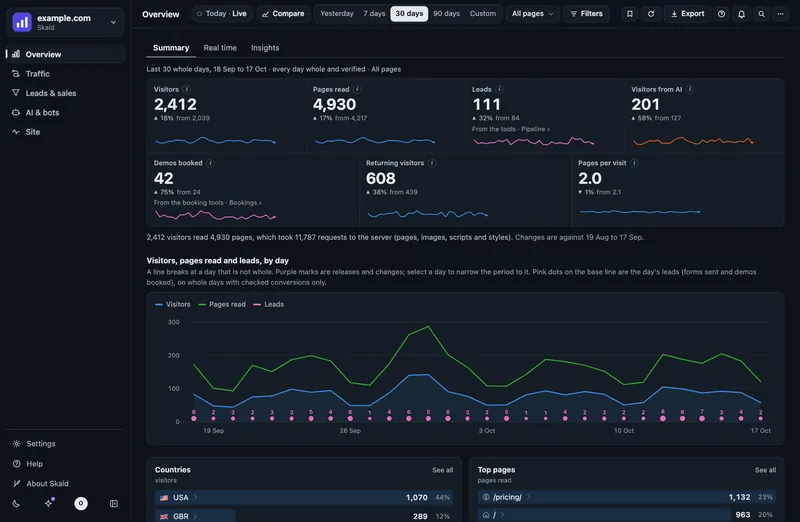
At 06:00 the log saw 3 of the day's 89 live fetches. The sampled answers tell you what an assistant would say; the log tells you how often it went to fetch your pages for someone, all day.
Sample day of ChatGPT-User, Perplexity-User and Claude-User fetches. The two are kept apart and never added: one counts fetches, the other answers. What the log adds: AI traffic
[04] to be fair
The right tool depends on the question you need answered first. Answer two, get one.
Skald's AI answers are one part of a log analytics tool, built for four assistants and up to 50 questions. Sometimes a tool built only for prompts, or the search engines' own reports, will serve you better. This says when.
1 · What do you need to know first?
2 · Which assistants, and how many questions?
Some prompt trackers now read server logs too: Profound's Agent Analytics page (read October 2026) says it "uses server logs instead of JavaScript trackers". Reading the log is the right idea. What each kind of tool does, as we read their docs in October 2026; tools change. If we have yours wrong, tell us.
[05] said plainly
What neither record can promise
Each record holds what the other cannot. Here is where both stop.
What it does not do
- Skald's AI answers are a labelled sample of API answers, on your own keys, at your cost, under a daily cap: a direction over weeks.
- A server log never holds the text of an answer, and never shows who asked.
- Clicks from AI are a floor. Visits that likely came from an assistant are an estimate, shown apart.
- Clicks from Google's AI Overviews look like any Google search visit. Only AI Mode can be told apart, by its udm=50 mark.
- Visits are an upper bound on people, never a count of them.
keep reading
More on prompt tracking vs server logs
questions
Prompt tracking vs server logs FAQ
Straight answers, including what Skald does not do.
What is the difference between prompt tracking and server log analytics?
Prompt tracking asks AI assistants a set of questions and records what the answers say: whether you are named, which pages are cited, which competitors appear. Server log analytics reads your web server's record of every request: the AI fetchers that read your pages, the crawlers, and the people who clicked through. One shows what was said; the other shows what happened.
Is Skald a prompt tracker?
Skald includes AI answer tracking: it asks ChatGPT, Perplexity, Gemini and Claude up to 50 questions through their APIs, from up to 10 places and languages a site. Its core is the server log. If you need other assistants, or answers as they look inside the apps, a tool built only for prompts may suit you better.
Can prompt tracking tell me whether AI sent me traffic?
Sampled answers show which links an assistant gave, not who clicked them. A click is recorded by your server, with the assistant's address as the referrer when the app sends one. Skald counts those clicks from the log, and shows direct visits that likely came from an assistant apart, as an estimate.
Why do AI answers change from one try to the next?
Assistants answer the same question differently from one try to the next, and by account, history, place and wording. That is why Skald asks each question 1 to 5 times and shows "named in 3 of 5", never a single yes or no. How tries per question work.
Should I replace my prompt tracker with Skald?
You don't need to. Keep the tool you use for answers, and add Skald beside it for what only your log and your leads can show: the fetches, the visits, and the leads that followed.
Can a server log see what ChatGPT said about me?
No. A log records requests to your site, never the text of an answer. That is why Skald samples the answers separately, with your own API keys, and keeps every answer so you can read it.
$ tail -f access.log | skald
See what AI does with your site. Free for 30 days.
No card. We set up hosted Skald for you within one working day, or you self-host it free. Every line of your log, sorted and added up.