Solutions · SaaS founders
AI traffic analytics for SaaS founders: what AI read before someone signed up
AI traffic analytics for SaaS founders answers the question your dashboard skips: which pages did ChatGPT, Claude or Perplexity read before someone signed up, booked a demo or paid?
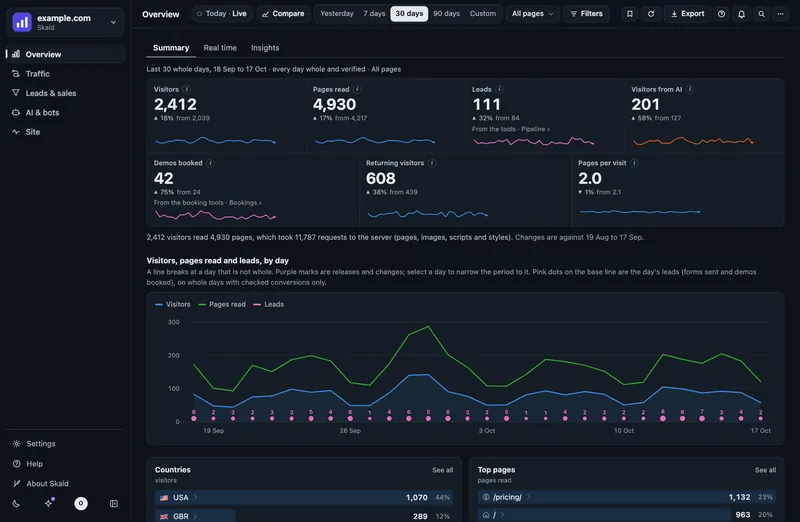
AI traffic analytics for SaaS founders joins three records your tools keep apart: the server log (what AI read, and who it sent), your sign-ups and payments (who became a customer), and a sample of AI answers (who named you). Skald lines them up by page and day, and never adds one to another. See lead attribution.
30-day free trial · no card · we set it up within one working day · free to self-host
- Mon 09:01 ChatGPT-User fetched /pricing/AI · live fetch
- Mon 09:02 visit /pricing/ ref chatgpt.compeople · from ChatGPT
- Thu 14:20 sign-up from your backend · first touch chatgpt.comlead
- Thu 14:31 Stripe · invoice paid · signed webhookpaid
Sample data. Four records from three roads: your log, your backend, Stripe.
[01] four questions
Four questions a SaaS founder asks about AI, and the record that answers each
Each question has its own proof. Skald keeps the four apart, so no number pretends to be another. Part of AI traffic analytics by role.
pick a question
Is your product named when buyers ask?
Write the questions your buyers ask, your brand terms and your competitors. Skald asks ChatGPT, Perplexity, Gemini and Claude on a schedule, 1 to 5 tries a question, and records who was named and which pages were cited. Every answer is kept in full, so you can read what was said.
"best invoicing tool for freelancers" · Perplexity · named you in 2 of 3 tries · cited /pricing/ → sample of API answers
Which pages assistants read for someone, right now
ChatGPT-User, Claude-User and Perplexity-User fetch a page while a person waits for an answer. Skald lists each assistant's fetches by page, and what they asked for: pages, llms.txt, Markdown, plain text. Training crawlers are counted apart, because nobody was waiting on them.
198.51.100.140 "GET /docs/api/" 200 "ChatGPT-User/1.0" → AI · live fetch
People who clicked through from an AI answer
A person who clicks a link in an answer counts as people, with the assistant as their source. Many apps strip the referrer, so these clicks are a floor. A direct visit to a page an assistant fetched minutes before is marked likely, and kept apart.
198.51.100.23 "GET /pricing/" 200 ref "chatgpt.com" → people · source ChatGPT
Sign-ups, demos and payments, joined to the visits before
Your backend sends each sign-up, your booking tool each demo, Stripe each payment, all signed. With the script tag on your pages and visitor IDs on, Skald joins each one to the journey before it, so a sign-up whose first visit came from ChatGPT shows ChatGPT as its first touch.
sign-up · first touch chatgpt.com · landing /pricing/ · 3 visits in 4 days → lead
[02] before the sign-up
Which pages AI read before someone signed up
Open a lead and you see its visits in order. On a visit from an AI answer, Skald lists the pages that assistant fetched in the 15 minutes before: nearest first, at most 10, with the landing page marked.
Those are the pages the answer was most likely built from. It is context, not a count of people, because a fetch can be for someone who never clicked. The join from sign-up to visits rides on an anonymous visitor ID from the script tag, so switch visitor IDs on for the site. Then Sources also shows the share of converting browsers that saw each page before converting, beside those that did not.
- Mon 09:01 · ChatGPT-User fetched/compare/
- Mon 09:01 · ChatGPT-User fetched/pricing/
- Mon 09:02 · from chatgpt.com/pricing/
- Mon 09:05/docs/api/
- Thu 14:18 · direct/signup/
- Thu 14:20 · your backend · signedSigned up. Lead.
Sample data. The visit came from ChatGPT and landed on the page ChatGPT had just fetched.
[03] sign-ups and payments
SaaS sign-up attribution: first touch, last touch and the pages between
Every source, assistant, campaign and landing page, with first and last touch side by side. Then how long it took, and how good the leads were.
Sign-ups from your backend
One file for PHP, Node or Python, one function call. It signs, retries safely and waits at most 3 seconds, so the sign-up never breaks.
Payments from Stripe
A signed webhook brings each payment in as a conversion, beside the sign-ups and bookings. Cancelled and test rows are listed, never counted.
Time to convert
From the first visit to the sign-up, in buckets from under an hour to over 90 days, and the visits it took.
Assisted touch
A source seen earlier in a converting journey that was not its last touch. Each conversion counts once per source.
[04] named in AI answers
Is ChatGPT naming your product, and what does it cost to check?
A tracking profile asks as if from one place, in one language: up to 50 questions, 1 to 5 tries each, daily, weekly or monthly. Up to 10 profiles a site.
It runs on your own provider keys. Each profile shows its cost estimate before you save it, and a run that would pass its daily cap stops and goes on the next day.
Sample data, one question, one assistant. A sample of API answers is a direction over weeks, never what every user sees.
[05] leads you can trust
Abandoned sign-ups, test accounts and spam, listed, never hidden
A founder's numbers get dirty fast: your own test sign-ups, a form started and finished on a phone the next day, a spam wave. Skald keeps each one in view and out of the counts.
Abandoned, or finished elsewhere
A form or booking started but not finished in 24 hours is abandoned. Finished later on another device, it counts as finished.
Test sign-ups from your server
Send your team's own accounts with
"test": true, or mark them later. They stay listed, and leave every count.Nothing hidden
Spam, duplicate and test leads, and cancelled or removed conversions, are listed in full under Show left out.
[06] what it does not do
The limits of AI traffic analytics for SaaS, said plainly
Every figure is one Skald can prove. Here is what that leaves out.
What it does not do
- AI clicks are a floor. Likely visits are estimates, shown apart and never added.
- What the AI read before a visit is context: a fetch can be for someone who never clicked.
- AI answers are a sample of API answers, on your keys and at your cost, not what every user sees.
- Joining a sign-up to its visits, pages seen before converting and assisted touch need the script tag with anonymous visitor IDs, off until switched on per site. Without them, sign-ups are counted with no journey.
- No in-app product analytics, no ad spend and no Google Ads link. Keep the tools you use for those.
keep reading
More on AI traffic analytics for SaaS founders
questions
AI traffic analytics for SaaS founders FAQ
Straight answers, including what Skald does not do.
Can I see which pages ChatGPT read before someone signed up?
Yes, as context, when the script tag runs with visitor IDs on, so the sign-up carries the browser's ID. Open the lead: its visits are listed, and on a visit from an AI answer Skald shows the pages that assistant fetched in the 15 minutes before, nearest first, at most 10. A fetch can be for someone else, so it is context, never a count of people.
How do I send sign-ups to Skald?
From your backend, with one downloaded file for PHP, Node or Python. You call one function when someone signs up. It signs the call, retries safely, and waits at most 3 seconds, so it never breaks the sign-up. The lead file from your backend.
Does Skald work with Stripe?
Yes. Stripe sends payments to Skald by a signed webhook, and they show as conversions beside the sign-ups and bookings, with cancelled and test rows listed but never counted. Stripe payment attribution.
Are sign-ups from ChatGPT counted exactly?
No. Many AI apps strip the referrer, so some people from AI answers arrive as direct visits. Skald counts only clicks that prove their source, so AI figures are a floor. A direct visit to a page an assistant fetched minutes before is marked likely, shown apart, and never added.
Does Skald replace my product analytics?
No. In-app product analytics, ad spend and the Google Ads link belong to tools built for them. Skald covers the website: who came, from where, what AI read, and which visits became sign-ups, bookings and payments.
$ tail -f access.log | skald
See what AI does with your site. Free for 30 days.
No card. We set up hosted Skald for you within one working day, or you self-host it free. Every line of your log, sorted and added up.