Compare · PostHog
Skald vs PostHog: what happens in the app, and what reaches the server
Skald vs PostHog is product analytics beside log analytics. PostHog follows what people do inside your app. Skald reads your server's log, so it sees every request, including the AI crawlers and scanners no SDK meets.
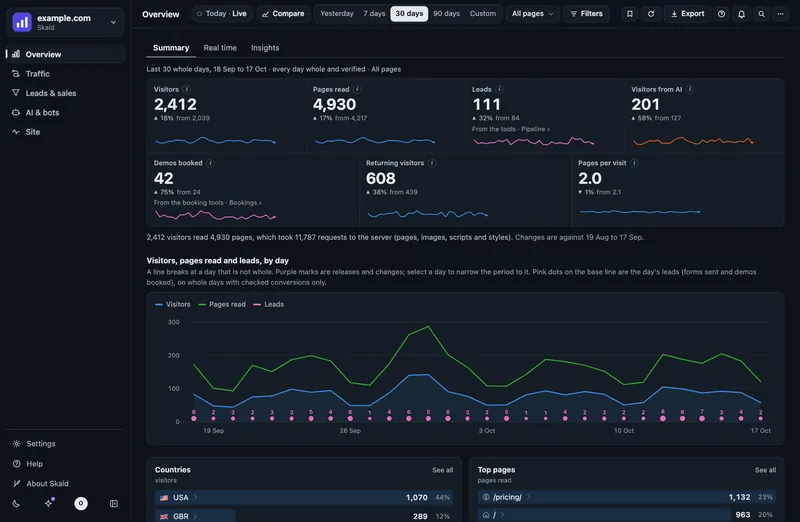
Skald vs PostHog compares two kinds of analytics. PostHog runs a JavaScript SDK in your pages and records events, funnels, paths and retention. Skald reads the access log your server already writes and sorts every request into five groups that add up to the log: people, AI assistants, search engines, bots and scanners, and your own traffic.
30-day free trial · no card · we set it up within one working day · free to self-host
- 09:14:02 198.51.100.7 "GET /app/" · runs the SDKSDK and log
- 09:14:03 198.51.100.7 clicked "Invite team"SDK event
- 09:14:06 203.0.113.24 "GET /pricing/" "GPTBot/1.2"log only
- 09:14:08 198.51.100.140 "GET /docs/setup/" "Claude-User"log only
- 09:14:11 192.0.2.77 "GET /.env" 404log only
Sample lines. An SDK sees what people do in the page. The server log sees every request, people and machines.
[01] question by question
Skald vs PostHog, question by question
Pick what you need to know. The table lights those questions and shows how PostHog and Skald answer them. Every comparison is on Skald alternatives and comparisons.
What do you need to know? pick one
AI and machines: PostHog blocks known bots by default and crawlers rarely run JavaScript, so it answers none of these 6. Skald answers all 6 from your server log.
| The question | PostHogJavaScript SDK | Skaldyour server log |
|---|---|---|
| Which AI training crawlers read your pages? (GPTBot, ClaudeBot) | No, known bots are blocked by default | Yes, page by page |
| Did an assistant fetch a page live, for someone? (Claude-User) | No | Yes, kept apart from training crawls |
| Why did the AI come: training, a live question, or a click? | No | Yes, three reasons, never added together |
| Which search engine crawlers came? | No | Yes, in their own group |
| Who is probing for .env and wp-login? | No | Yes, with what your server answered |
| Block AI crawlers, per AI company | No | Yes, applied by your web server; it does not charge |
| Visitors and visits | Yes | Yes, as an upper bound on people |
| Each visit's pages in order | Yes, user paths | Yes |
| People who clicked through from an AI assistant | Yes, an AI channel type | Yes, by assistant; a floor, as apps strip referrers |
| UTM campaigns | Yes | Yes, with campaign tag problems flagged |
| Visitors with an ad-blocker | It advises a reverse proxy against blockers | Yes, the server logs every request |
| Visitors who decline cookies | A cookieless mode option | Yes, the log needs no cookie |
| Works where you cannot read the server's log | Yes | People only, with the script tag; no AI or bots |
| Events inside the page (clicks, sign-ups) | Yes | Yes, with the optional script tag |
| Funnels | Yes | Yes, counted every day by source and device |
| Retention cohorts | Yes, a retention insight | Yes, by week, split by first source |
| Leads by source and AI assistant | Events by channel | Yes, first and last touch, from signed webhooks |
| Totals must add up, or the day is withheld | No | Yes |
| A second, separate recount of every figure | No | Yes, every day |
| Server errors (5xx) by page | No | Yes, from the status in each log line |
| 404s, and who met them | A site health scout | Yes, people apart from probes and crawlers |
| Runs on your own server | Self-host is unsupported; it supports only its cloud | Yes, free to self-host |
| Email alerts | Yes, on insights | Yes, site, AI and security alerts |
What each tool is built to do, as we read their own docs in October 2026. If we have yours wrong, tell us.
[02] to be fair
Where PostHog does more than Skald
PostHog is built for product teams. Here is where it is the better tool.
Inside the app
Events, funnels with in-app steps, user paths and retention are its home ground. A script in the page sees what a server log cannot.
Any host
Its SDK works wherever your pages run. Skald needs a server or CDN log to see machines; without one, its script tag sees people only.
An MIT licence
PostHog's self-host code is MIT, though it supports only its cloud. Skald is source-available under the Elastic License 2.0.
[03] before the sign-up
What reached your site before anyone opened the app
Product analytics starts when the SDK loads. The server log starts earlier: the AI assistant that read your docs, the visit it sent, and the lead that followed.
Skald joins a lead from a signed webhook to the visits before it, and lists what the assistant fetched in the minutes before the click.
- Mon 09:01 · Claude-User fetched/docs/setup/
- Mon 09:02 · from claude.ai/docs/setup/
- Mon 09:05/pricing/
- Wed 16:40 · direct/signup/
- Wed 16:42 · lead, signed webhooksign-up · first came from claude.ai
Sample journey. The fetch is context, not a person; the visits and the lead are counted.
[04] use both
Keep PostHog for the product, add Skald for traffic and the server
Skald needs nothing in your pages, so it never touches PostHog's SDK. Each answers its own questions.
Keep PostHog for
What people do inside your app: feature events, in-app funnels, paths and retention.
Add Skald for
AI crawlers and live fetches, search crawlers, scanners, server errors, and which source sent each lead.
Check the figures
Every Skald figure adds up to the log and is counted twice. A day that does not agree is withheld.
[05] choose by the question
PostHog, Skald, or both
- "Which features do signed-in users use?" PostHog.
- "Which AI assistants read our docs?" Skald, from the log.
- "Which source sent the leads that signed up?" Skald, from signed webhooks.
- "Is our server answering crawlers with errors?" Skald's crawl health.
What it does not do
- Skald is not product analytics: it does not follow what signed-in users do inside your app.
- Without a server or CDN log, Skald sees people only, through its script tag: no AI crawlers, fetchers or bots.
- What the AI read before a visit is context, never a count of people.
- AI clicks are a floor: an app that strips the referrer sends a direct visit.
keep reading
More on Skald vs PostHog
questions
Skald vs PostHog FAQ
Straight answers, including what Skald does not do.
Does PostHog show AI crawlers?
No. As we read PostHog's own docs in October 2026, it blocks known bots by default, and crawlers rarely run JavaScript anyway. Skald reads the server log, so it shows each AI crawler and each live fetch by an assistant, checked against its owner's published addresses.
Is Skald a PostHog alternative?
Not for product analytics. PostHog is built for what people do inside your app. Skald is built for every request your server answers, with leads joined to the pages they read. Many teams use both.
Can I self-host PostHog?
Its self-host code is MIT, but PostHog's docs say it supports only its cloud. Skald is source-available under the Elastic License 2.0 and free to self-host on your own server, or we host it for you.
Do PostHog and Skald both do funnels?
Yes. PostHog has funnels. Skald's funnels are built from each visit's pages in order, optionally from one source, and each saved funnel is counted every day by source and device. A step can also be an in-page event or a lead.
Which one counts visitors with an ad-blocker?
Skald, because the server writes a line whatever the browser blocks. PostHog advises a reverse proxy to get past blockers.
Can I run PostHog and Skald together?
Yes. Skald needs nothing in your pages, so it never touches PostHog's SDK. Keep PostHog for the product, and add Skald for traffic, AI and the server.
$ tail -f access.log | skald
See what AI does with your site. Free for 30 days.
No card. We set up hosted Skald for you within one working day, or you self-host it free. Every line of your log, sorted and added up.