Features · what changed
Is it working? Now against before, with the dates said out loud
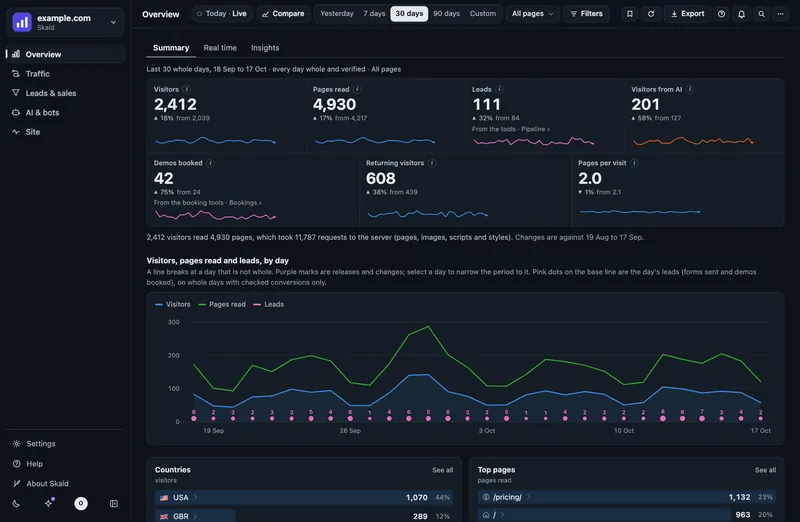
A number on its own says nothing: 412 visits by people this week is good news or bad news only beside last week. Skald's website traffic comparison puts every figure on Summary and Pages beside the same days just before, and names those days.
Compare with the period before sets the same number of whole days just before your period beside it: the last 7 whole days, 8–14 Jan, against 1–7 Jan. A gap of 3 visits or fewer reads “about the same”, and days Skald never measured read “before: not measured”, never a rise.
30-day free trial · no card · we set it up within one working day · free to self-host
Last 7 whole days: 8–14 Jan compared with 1–7 Jan
7 complete days ending yesterday. On 15 Jan that is 8–14 Jan against 1–7 Jan · northwind.example is measured from 1 Dec · every day checked against the raw log
Sample site measured from 1 Dec. The words are the ones Skald's period line writes; try 30 days with Compare on, or Include today.
[01] how much, from where
How much traffic came, and did it rise or fall?
Summary opens on five figures: People, From search engines, Returning people, Leads and Sent by AI assistants. With Compare on, each one carries its change and the figure it is set against, and the whole tile opens the tab it comes from.
Leads · sample tile
16
▲ 33% · before: 12
4 more than before, so the arrow shows. A gap of 3 or fewer would read “about the same”.
drag the figure
Sample tiles for the last 7 whole days against the 7 before. People are visits that read a page, an upper bound on people.
Sent by AI assistants counts proven clicks only (a referrer or a tag). Visits only likely sent by AI are kept apart, and Skald now checks them against chance: on skaldanalytics.com itself, 18 to 24 Oct, they fell from 54 to 1 once typed-in visits to a busy page (/check/) stopped being credited, as Skald's 2.35.0 release notes (25 Oct 2026) record.
[02] what is working
Which sources and landing pages are working?
The card “What changed: is it working?” lists your sources and your landing pages, each with Now, Before and the change, then says in one sentence how many more or fewer people came and the biggest rise and drop. Each row opens its own detail.
More people than the period before: 412 against 349. Biggest rise: /blog/server-logs/ (72 to 120). Biggest drop: Search engine (176 to 160).
- Search engine 160 · 176▼ 9%
- Direct or unknown 123 · 89▲ 38%
- Other website 64 · 40▲ 60%
- Social media 29 · 27≈ about the same
- Email 22 · 11▲ 100%
- AI assistant 14 · 6▲ 133%
- /blog/server-logs/ 120 · 72▲ 67%
- / 96 · 110▼ 13%
- /pricing/ 88 · 61▲ 44%
- /features/ 40 · 38≈ about the same
- /docs/setup/ 30 · 31≈ about the same
- /blog/fall-launch/ 8 · 0▲ new
Sample visits, the last 7 whole days against the 7 before. “About the same” is a gap of 3 visits or fewer: normal day-to-day swing at these numbers. The sentence weighs both lists, as the card does.
[03] CRO or more traffic
Work on the page, or on getting more traffic?
More visitors will not fix a page that nearly everyone leaves at once. The card “Work on the page, or on traffic?” reads each landing page's visits from your log and sorts the ones that need work into two lists, with the rule written beside them. CRO (conversion rate optimisation) means working on the page itself, so more of the people already arriving stay and act.
88 visits started here and 81 of them left at once (92%), with no form sent. The traffic is there; the page loses it. Work on the page (CRO).
Improve the page
At least 10 visits started on the page, 9 in 10 of them left at once, and no lead began there.
Both
Search found the page at least 3 times in the period, and 8 in 10 of its visits left at once.
Sample pages, the share that left at once in each bucket. A bucket tips only when its page meets a list's whole rule: left for Improve the page, right for Both. Left at once: the visit loaded that one page and no other, one page view in the server's log. Each list shows at most 5 pages; all of them are on Traffic › Pages, sorted by Needs work.
[04] new pages
Which new and updated pages started getting found?
You published a page last week; has anyone found it? This card takes the pages changed in the last 30 days, by your website's own dates or your sitemap's “last changed” (<lastmod>), and shows what happened since each change.
Dates from your sitemap (“last changed”). 5 pages changed since 16 Dec: 4 had a visit, 4 a visit from search, 1 none yet. Google fetched 4 of them. Its own period: the last 30 days to 14 Jan.
| Page | Changed | Visits | Search | 1st search | Google fetched |
|---|---|---|---|---|---|
| /docs/changelog/ | 13 Jan | 0 | 0 | none yet | not yet |
| /blog/fall-launch/ | 9 Jan | 8 | 5 | 11 Jan | 13 Jan |
| /pricing/ | 6 Jan | 104 | 14 | 7 Jan | 12 Jan |
| /blog/server-logs/ | 2 Jan | 151 | 80 | 3 Jan | 14 Jan |
| /features/ | 18 Dec | 152 | 30 | 19 Dec | 10 Jan |
Sample. “Google fetched” is the last day a verified Googlebot fetched the page since the change, from crawl health.
Dates look like build times: 96 of the 120 dated pages in your sitemap say 14 Jan. A site that stamps every page when it is built makes every page look changed; check how your sitemap sets “last changed”.
Spread over weeks, as real edits are: the card can trust them.
Sample sitemap of 120 dated pages, one stamp for every 6. The warning shows when more than half the dated pages carry one date, and at least 10 are dated.
[05] which page is doing well
Which page is doing well, and which is slipping?
Traffic › Pages sorts the landing pages five ways with one chip, kept in the address as psort. Rising and Falling need Compare; without it the list stays on Most visits and says why.
- 1/blog/server-logs/120+4886%2 Jan
- 2/96−1452%1 Dec
- 3/pricing/88+2792%6 Jan
- 4/features/40+255%18 Dec
- 5/docs/setup/30−193%14 Nov
- 6/blog/fall-launch/8+8100%9 Jan
Most visits first: the visits that started on each page.
Sample landing pages, the last 7 whole days. Needs work ranks pages with 10 visits or more, the most left at once first; a page under 10 visits has no score and sorts last.
[06] the honest part
Where a comparison stops being fair
Each card says when it cannot compare, rather than show a figure that would mislead. These are the cases, so none of them surprises you.
What it does not do
- It does not compare a period that includes today: today is not over. Only Today · Live compares it, with yesterday up to the same time.
- It does not say why a figure moved. It shows which source or page moved and by how much; the reason is yours to find, and a page you changed can be tracked on its own.
- “Left at once” comes from the server's log. A single-page app (a site that swaps its content in the browser after the first load) can show a new step without asking the server, and that step is missing from the log, so on such a site the share is an upper bound.
- Leads per landing page need the conversions data; without it a page says “forms: not recorded”.
- Visits by landing page are kept from the first day collected after the 2.35.0 upgrade (release notes, 25 Oct 2026); older days say “not recorded”, never 0. A page group shows these cards for the whole site only.
- Change dates are what your site says. Skald can warn when they look like build times, but it cannot tell a real edit from a re-stamp on its own.
keep reading
More on website traffic comparison
questions
Website traffic comparison FAQ
Straight answers, including what Skald does not do.
What does Compare with the period before compare?
The same number of whole days just before your period. On 15 Jan, the last 7 whole days are 8–14 Jan and the period before is 1–7 Jan. Yesterday is set against the day before. The line under the title says the dates in words, so you never have to work them out.
Can I include today in the comparison?
You can include today in the period: with 7, 30 or 90 days, Include today ends the period today and counts today so far. That period is not compared, though. Today is not over, so its figures would always look lower than a whole day's. Turn Include today off to compare whole days, or use Today · Live, which sets today against yesterday up to the same hour.
Why does a tile say “about the same” when the number moved?
A change of 3 visits or fewer reads “≈ about the same”, with the earlier figure beside it. At small daily counts, a gap that size is normal day-to-day swing, and an arrow with a big percentage would only alarm you.
What does “before: not measured” mean?
The period before falls on days Skald did not count yet, usually before it started reading your site. Skald says so, and names the first day a full comparison comes, instead of showing a 0 or a rise against nothing.
Should I work on the page or on getting more traffic?
Summary's card “Work on the page, or on traffic?” answers it from your own log. A page where at least 10 visits started, 9 in 10 left at once and no lead began there needs the page improved. A page search found at least 3 times where 8 in 10 left at once needs work on both the page and how it is found.
How do I see which new pages are getting found?
Summary's card “New and updated pages” lists the pages changed in the last 30 days, by your website's own dates or your sitemap's “last changed” dates, with their visits and search visits since, the first search visit and whether Google fetched them. If most sitemap dates fall on one day, the card warns they look like build times.
$ tail -f access.log | skald
See what AI does with your site. Free for 30 days.
No card. We set up hosted Skald for you within one working day, or you self-host it free. Every line of your log, sorted and added up.